AHA SURF Program
Summer Undergraduate Research Fellowship
A 10-week cardiovascular research experience at the University of Arizona, funded by the American Heart Association
Applications Open January 13, 2026
Program Overview
$6,000 Stipend
Competitive funding for your 10-week research experience
$3,000 Travel Award
Present your research at AHA Scientific Sessions
10-Week Program
Full-time summer research with expert mentorship
Cardiovascular Research
Cutting-edge labs studying heart disease
Eligibility Requirements
Student Requirements
- Junior or Senior academic status (or graduating)
- Enrolled full-time at a 4-year college/university
- U.S. citizen or eligible visa holder (F-1, H1, H1B, J1, PR, TN)
- Interest in cardiovascular research careers
Application Materials
- Resume or CV
- Unofficial transcript
- Personal statement (1-2 pages)
- One letter of recommendation
Research Mentors
World-class faculty dedicated to training the next generation of cardiovascular researchers

Dr. Jared Churko
Associate Professor
Department of Cellular and Molecular Medicine
Dr. Churko is Director of the UA AHA SURF program. His laboratory focuses on using human induced pluripotent stem cell (iPSC)-derived cardiomyocytes to model inherited cardiac diseases and develop novel therapeutic approaches.

Dr. Brett Colson
Associate Professor
Department of Cellular and Molecular Medicine
Dr. Colson investigates interactions and dynamics of proteins involved in muscle contraction, dysfunction in muscle disorders, and intervening therapies. His research focuses on how mutations in myosin binding protein-C cause hypertrophic cardiomyopathy.

Dr. Henk Granzier
Professor
Department of Cellular and Molecular Medicine
Dr. Granzier is a world-renowned expert on titin, the largest protein in the human body and a key determinant of cardiac and skeletal muscle function.

Dr. Sakthivel Sadayappan
Professor & Department Head
Department of Cellular and Molecular Medicine
Dr. Sadayappan is Head of the Department of Cellular and Molecular Medicine and Associate Director of the Sarver Heart Center. His research focuses on treating and preventing genetically induced heart failure.

Dr. Samantha Harris
Professor
Department of Cellular and Molecular Medicine & Physiology
Dr. Harris studies the molecular mechanisms of cardiac muscle contraction, with a focus on how mutations in myofilament proteins lead to cardiomyopathies.

Dr. Gregory Thatcher
Professor
R. Ken Coit College of Pharmacy
Dr. Thatcher's research program focuses on the development of novel small molecule therapeutics for cardiovascular and neurological diseases.

Dr. Hongmin Li
Professor
R. Ken Coit College of Pharmacy
Dr. Li's laboratory focuses on therapeutic development and structural biology, with research on cancer and infectious disease targets.

Dr. Shanna Hamilton
Assistant Professor
Department of Cellular and Molecular Medicine
Dr. Hamilton studies calcium signaling in the heart, with a focus on how abnormal calcium handling contributes to arrhythmias and heart failure.

Dr. Toshinobu Kazui
Associate Professor
Department of Surgery, Division of Cardiothoracic Surgery
Dr. Kazui's research focuses on translational cardiovascular research and surgical outcomes in cardiac and aortic disease.

Dr. Curtis Thorne
Associate Professor
Department of Cellular and Molecular Medicine
Dr. Thorne's laboratory investigates Wnt signaling pathways controlling cell fate in the gut and colorectal cancer.
Administrative Support
Becca Van Sickler, MEd
Program Coordinator, Senior
Dept. of Cellular & Molecular Medicine
Maricela Pier
Student Coordinator
Program Timeline
Key dates for the AHA SURF Summer 2026 program
Applications Open
Online application portal opens. Call for applications posted to social media and campus flyers.
Application Deadline
All application materials must be submitted by 11:59 PM MST.
Selection Complete
Selection committee completes review.
Award Notices Sent
Award notices and appointment letters sent to selected fellows.
Program Begins
Orientation at MRB 301, meet program leadership, review syllabus, AHA membership.
Final Presentations
End of program research presentations at MRB 102.
Important Dates at a Glance
2024 SURF Fellows
Meet our inaugural cohort and hear about their experiences
Cole Bauer
Physiology/Medical Sciences
Mentor: Dr. Shanna Hamilton
“SURF definitely shaped my career goals. Before the program, I knew I liked science, but I wasn't sure how much I would enjoy real lab work. Getting to work on the TECRL-CPVT project showed me how exciting it is to investigate a question no one fully understands yet.”
Yash Rohilla
Biology
Mentor: Dr. Toshinobu Kazui
“The SURF program solidified my interests into pursuing a career in academic medicine in the cardiovascular field. The most meaningful part was the community formed through all the mentors available to help and the fellow students I was learning with.”
Isabella Tran
Physiology/Medical Sciences
Mentor: Dr. Jared Churko
“SURF has made me more interested in cardiovascular drug discovery and has expanded greatly on my research techniques. The most meaningful part has been being able to work in a lab of people who are supportive, patient mentors that I could rely on.”
Elaine Kang
Molecular and Cellular Biology
Mentor: Dr. Henk Granzier
“The SURF program solidified my commitment to pursuing a career in medicine while also deepening my appreciation for the scientific basis of patient care. It exposed me to the diversity of cardiovascular research.”
Adriana Frost
Nutritional Sciences
Mentor: Dr. Samantha Harris
“The most meaningful part of SURF was connecting with other students in a research setting and improving our scientific knowledge as a cohort. It helped me grow more confident and proficient in a research environment.”
What Mentors Say
“Bella quickly became an integral part of our research team. Her dedication to mastering complex techniques like calcium imaging and her ability to independently troubleshoot experiments exceeded expectations for an undergraduate researcher.”
“He listens well and works hard toward success. His steady growth reflects his commitment and resilience.”
“His presentations in the lab meetings and journal clubs were almost at a graduate student level, with thorough and clear delivery.”
Frequently Asked Questions
Find answers to common questions about the AHA SURF program
The program is open to undergraduate students who are U.S. citizens or permanent residents, currently enrolled at an accredited college or university, and have completed at least their freshman year by the start of the program.
Prior research experience is not required but is considered favorably. We welcome students at all stages of their research journey.
Yes, all participants receive a competitive stipend funded by the American Heart Association. Stipends are paid in installments throughout the program.
Housing is not directly provided, but we assist out-of-town students in finding affordable summer housing options near campus.
A complete application includes: online application form, current resume/CV, unofficial transcript, personal statement, and one letter of recommendation.
Application review typically takes 4-6 weeks after the deadline. You will be notified of your status via email by mid-March.
Still have questions?
Email us at jchurko@arizona.eduProgram Highlights
See our SURF fellows in action
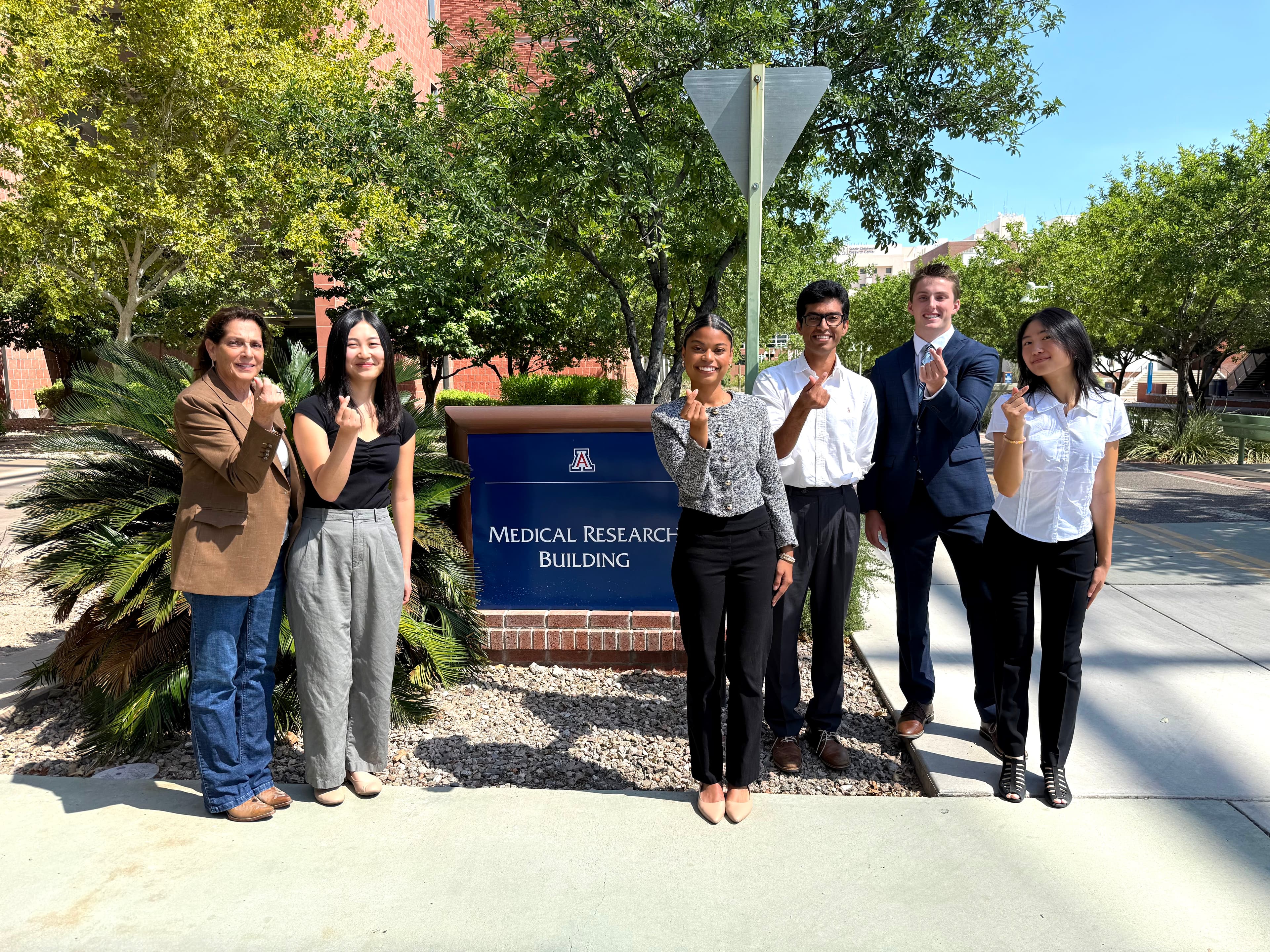
2024 SURF Fellows at the Medical Research Building
Ready to Start Your Research Journey?
Join a cohort of talented undergraduates and gain hands-on experience in cardiovascular research.
Apply Now